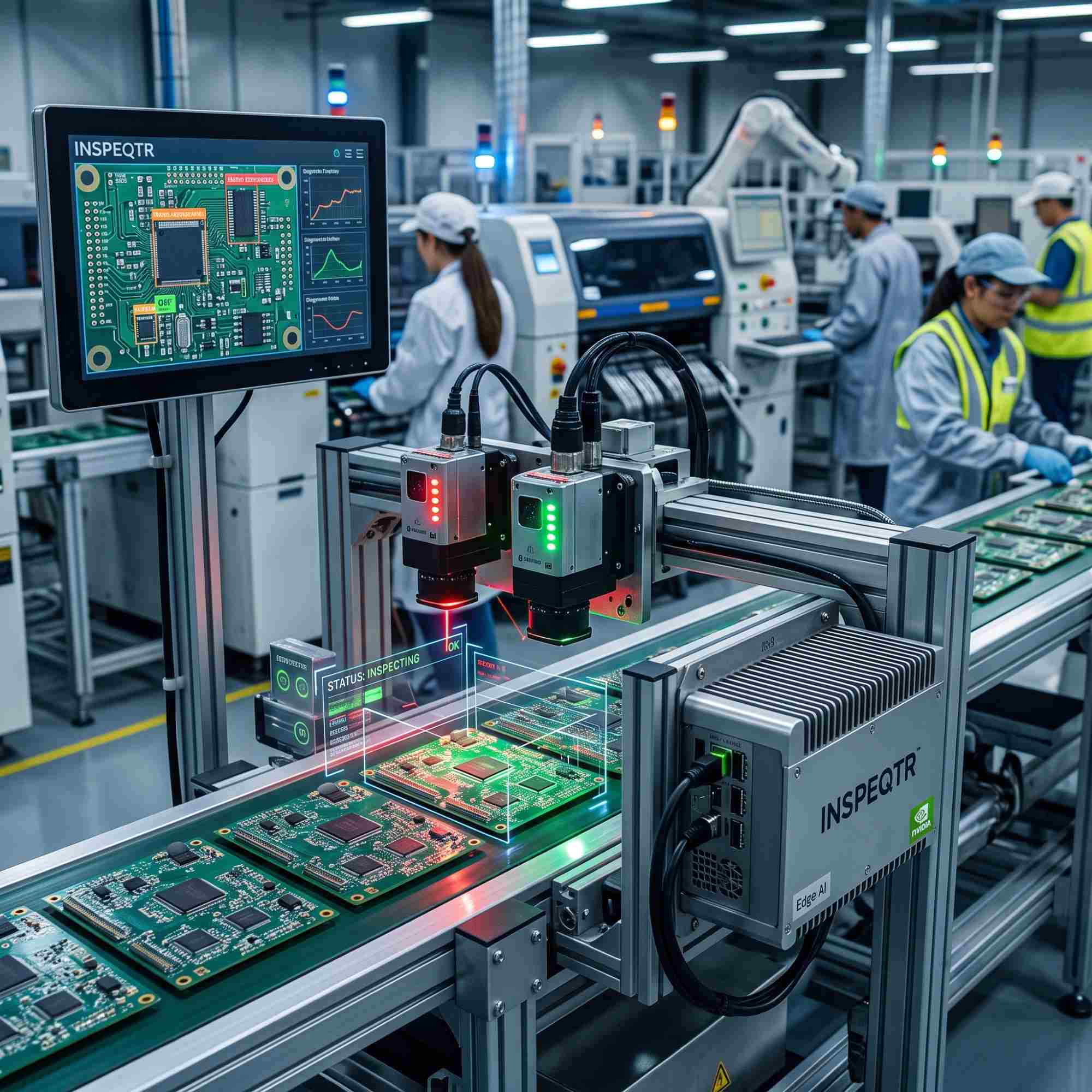
Modern electronics manufacturing plants require fast inspection to catch microscopic assembly faults. Inspeqtr delivers production-grade industrial visual inspection and NVIDIA Edge AI workflows directly on factory assembly lines. Therefore, facilities eliminate expensive manual bottlenecks while boosting overall product reliability.
High-Precision Manufacturing: Why Automated Defect Inspection Matters
Precision manufacturing spans electronics, automotive parts, semiconductor packaging, and medical devices. Across these high-speed lines, tiny physical components move along conveyor belts at meters per second. Manufacturers produce billions of precision units across global factories every year.
The Exponential Cost of Manufacturing Defects
However, microscopic manufacturing errors frequently compromise electrical performance. A tiny missing drill hole or an accidental copper short can disable an entire assembly. Consequently, catching these manufacturing defects early protects factory profit margins.
| When a defect is found | Cost to fix |
|---|---|
| During initial fabrication | ~$0.10 (rework or discard the board) |
| During final product assembly | ~$5–50 (disassemble and rework) |
| In the customer’s hands | ~$100–500+ (warranty claim, brand damage, recall) |
As shown above, costs multiply exponentially when defects escape early production stages. Finding an error during bare-board fabrication costs only pennies. In contrast, diagnosing a field failure after customer delivery triggers severe warranty expenses.
Why Manual Human Inspection Cannot Scale
Historically, electronics manufacturing plants relied on human visual inspectors. However, human operators experience eye fatigue and miss small solder irregularities. Furthermore, human inspectors can evaluate only a few hundred boards per hour.
Modern surface-mount assembly lines produce thousands of high-density boards every hour. Therefore, human visual inspection creates an unacceptable operational bottleneck. Automated edge AI systems eliminate this bottleneck by inspecting boards directly on the line in real time.
Why Industrial Visual Inspection with NVIDIA Edge AI Matters for Modern Factories
Inspeqtr provides an integrated, end-to-end industrial inspection platform. Specifically, the system executes two distinct, coordinated responsibilities across the manufacturing lifecycle.
Real-Time Edge Inference on Assembly Lines
First, industrial cameras stream high-resolution video directly from conveyor lines. The edge node executes optimized deep learning models on every incoming frame. As a result, the inference engine detects minute defects with precise bounding boxes in real time.
Furthermore, the system publishes telemetry alerts to remote monitoring dashboards with sub-second latency. Operators receive instant notifications before defective boards reach downstream assembly stations.
Continuous ML Lifecycle Management
Second, the platform maintains a continuous machine learning feedback loop. Quality engineers capture genuine factory anomalies and annotate challenging edge cases. Subsequently, workers initiate distributed training runs using validated dataset snapshots.
After training finishes, engineers evaluate model metrics inside MLflow. Finally, plant administrators deploy approved neural networks over the air without interrupting running factory lines.
Why NVIDIA? The Hardware and Acceleration Story
Inspeqtr adopts a modular, hardware-flexible design by architecture. Specifically, the codebase runs on both Intel and NVIDIA processors. However, this guide focuses on the high-throughput NVIDIA acceleration pathway.
| Component | NVIDIA-specific technology | What it does |
|---|---|---|
| GPU | CUDA-enabled NVIDIA GPU (Jetson Orin, RTX series, etc.) | Accelerates inference |
| Inference framework | the Edge DeepStream Inference Service | A custom Python server with GStreamer + TensorRT |
| Model format | ONNX → TensorRT .engine | GPU-compiled, GPU-optimized model |
| Video encoding | NVENC (hardware encoder) | H.264 video for WebRTC streaming |
| WebRTC streaming | GStreamer + MediaMTX (WHIP/WHEP) | Streams annotated video to browser |
Because industrial lines run at high speeds, GPU acceleration ensures deterministic throughput. Therefore, running our industrial visual inspection NVIDIA edge AI stack on NVIDIA hardware delivers consistent real-time results.
Automated Hardware Provisioning
Engineers switch target hardware configurations through an automated shell script during initial deployment:
the hardware selection script
# → writes INFERENCE_ENGINE=deepstream
# → writes INFERENCE_ENGINE_URL=http://localhost:8088
This automated helper writes the required variables into the local .env configuration file. If an operator skips this initialization step, Docker Compose halts immediately with a clear explanatory error. Consequently, the initialization guard prevents accidental misconfigurations before containers launch.
The Complete Technology Stack Explained
The Inspeqtr platform coordinates specialized open-source tools across edge and cloud domains.
Platform Technology Catalog
| Technology | Role | Files |
|---|---|---|
| Rust | Orchestration, control plane, OTA agent, edge bridge | The Edge Orchestration Bridge, the Central Cloud Orchestrator, the Over-The-Air Update Agent, the Dataset Curator Web Service |
| Python | AI inference, model training, DeepStream server | the Edge DeepStream Inference Service, the Training Subsystem, the Vision Pipeline CLI |
| Docker Compose | Runs all services as containers on one machine | docker-compose.yml, docker-compose.featureflag.yml |
| GStreamer | Video pipeline framework (decode, process, encode, stream) | The GStreamer pipeline manager |
| TensorRT | NVIDIA’s model compiler (converts ONNX to GPU-optimized engine) | The TensorRT Inference Engine session worker |
| ONNX | Portable model format | Exported by the GPU Vision Training Engine |
| YOLO11 | The object detection algorithm that spots defects | the Training Contracts specification librarysrc/klyff_contracts/model_catalog.json |
| WebRTC / WHIP | Protocol for streaming live annotated video to a browser | the Edge DeepStream Inference Servicewebrtc/ |
| MediaMTX | Media relay server that receives GStreamer WHIP stream and serves it to browsers | Configured in compose |
| Coturn | TURN server for NAT traversal (makes WebRTC work through firewalls) | the Production Configuration Suitecoturn/ |
| MQTT | Lightweight pub/sub messaging for edge predictions | The Edge MQTT Broker container the Edge DeepStream Inference Servicetelemetry/mqtt_sink.py |
| RustFS | S3-compatible object storage for images, datasets, and models | Compose service rustfs |
| MLflow | ML experiment tracking ( logs metrics, parameters, and model artifacts ) | the MLflow Tracking Service |
| PostgreSQL | Database for training job state, projects, datasets, approvals | Compose service postgres |
| Klyff | Cloud IoT platform ( device registry, telemetry dashboard, OTA commands ) | Our Product |
| NGINX | Reverse proxy in front of MLflow | The NGINX Reverse Proxy |
Why We Selected Rust for the Control Plane
We implement our core control plane services using Rust. Because Rust compiles directly to native machine code without a garbage collector, memory consumption remains predictable.
Rust’s strict memory safety guarantees eliminate segmentation faults during 24/7 industrial shifts.
Why We Chose Python for ML Workloads
In contrast, our team leverages Python for model training and DeepStream orchestration. Python hosts premier computer vision ecosystems including PyTorch, Ultralytics YOLO, and NVIDIA TensorRT bindings.
Because Python provides mature data science libraries, researchers prototype new algorithms rapidly. Therefore, pairing Rust stability with Python agility creates an optimal industrial software architecture.
5. System Architecture and Component Coordination
The following diagram demonstrates how industrial visual inspection NVIDIA edge AI services coordinate data streams across edge and cloud layers:
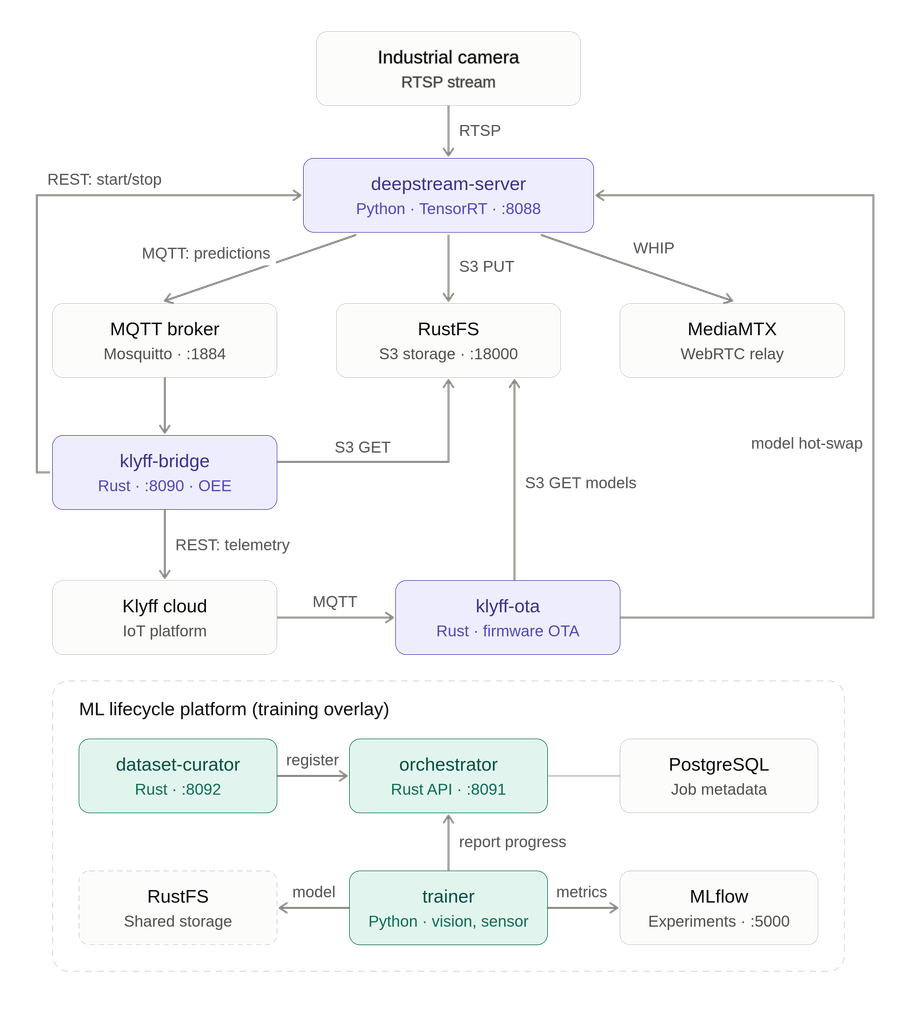
deepstream-server Ingests RTSP video from cameras and runs GPU inference. Meanwhile, klyff-bridge aggregates prediction payloads over local MQTT topics. Furthermore, background workers transfer high-resolution defect snapshots directly to RustFS object storage.
Architectural Subsystem Roles
| Subsystem Component | Operational Responsibility | Architectural Rationale |
|---|---|---|
| Edge DeepStream Engine | Hardware-accelerated frame ingestion, TensorRT execution, video encoding | Directly interfaces with high-speed line cameras with sub-12ms inference latency |
| Edge Orchestrator Bridge | MQTT subscription, frame-to-unit sessionization, OEE metric calculation | Decouples video decoding from factory telemetry dispatch and business logic |
| Zero-Downtime Model Manager | Model extraction, validation, shadow pipeline activation, atomic rotation | Ensures models swap dynamically without interrupting active camera streams |
| Autonomous OTA Daemon | Cryptographic package verification, state backup, automated health checks | Guarantees unbricked, self-healing edge nodes across remote factory facilities |
| Central Cloud Orchestrator | Tenant authentication, training job dispatch, human approval gates | Centralizes business governance while keeping edge nodes resilient during outages |
| Dataset Curator Service | Raw frame ingestion, operator review canvas, deterministic release generation | Eliminates training data contamination while enforcing human review verification |
| GPU Model Trainer | Multi-task family training (YOLO11, RT-DETR, XGBoost, PyTorch LSTM) | Exports universal artifacts optimized for target edge accelerator platforms |
Understanding the Two Compose Files
The platform maintains two distinct Docker Compose profiles for edge and cloud workloads.
Always-On Edge Stack: docker-compose.yml
First, docker-compose.yml defines the core runtime environment for the factory floor. This baseline deployment runs continuously during manufacturing shifts:
klyff-bridgemanages local device orchestration and metric reconciliation.mqtt-brokerdistributes real-time telemetry events between microservices.rustfshandles local S3-compatible image and artifact storage.klyff-otaapplies authenticated model updates wirelessly.deepstream-serverperforms GPU-accelerated video inference under thenvidiaprofile.
On-Demand Training Overlay: docker-compose.featureflag.yml
Second, docker-compose.featureflag.yml provides an auxiliary machine learning training stack. Operators deploy this overlay when training new detection models:
postgresstores project definitions, datasets, and job metadata.orchestrator-apiprovides REST endpoints for scheduling training tasks.mlflowandmlflow-nginxtracks hyperparameters, loss curves, and model weights.dataset-curatordelivers a browser-based annotation interface.model-managerValidates and promotes high-performing model candidates.vision-trainer-imageandlocal-training-workerexecutes deep learning training jobs.sensor-inferenceExposes a dedicated FastAPI service for sensor anomaly models.
Recap
- Inspeqtr provides a production-ready industrial visual inspection NVIDIA edge AI architecture for high-speed electronics assembly lines.
- The runtime separates high-speed inference in
deepstream-serverfrom control plane orchestration inklyff-bridge. - We implement control logic in Rust for guaranteed memory stability while using Python for machine-learning agility.
- In addition, the initialization script configures
INFERENCE_ENGINE=deepstreamautomatically to protect against runtime misconfigurations. - The repository cleanly separates workloads between continuous factory inference and on-demand model retraining overlays.
Glossary
Core Platform Terminology
| Term | Meaning |
|---|---|
| PCB | Printed Circuit Board: the green board with electronic components |
| Edge node | A computing device physically located in the factory |
| NVIDIA Jetson | NVIDIA’s edge GPU module (Jetson Orin, Nano, etc.) common in factory deployments |
| TensorRT | NVIDIA’s model optimization framework compiles ONNX to a GPU-specific format .engine |
| ONNX | Open Neural Network Exchange a portable model format |
| GStreamer | An open-source multimedia pipeline framework used to build video processing graphs |
| WHIP | WebRTC HTTP Ingestion Protocol used to send video streams to MediaMTX |
| WebRTC | Web Real-Time Communication browser-native protocol for low-latency video |
| MQTT | Lightweight publish/subscribe messaging protocol used for edge telemetry |
| RustFS | An S3-compatible object storage server written in Rust |
| MLflow | Open-source ML experiment tracking: logs parameters, metrics, and model files |
| OTA | Over-The-Air remote software/model updates without physical access |
| ADR | Architecture Decision Record: a document explaining why a design choice was made |
| Monorepo | One Git repository containing multiple services and shared libraries |
| INFERENCE_ENGINE | The env var that tells klyff-bridge which inference backend to use: deepstream or dlstreamer |
Hands-On Exercises
- Explore the repository layout. Open your terminal and run
find . -maxdepth 2 -type d | sortin the root folder. Match each returned directory to the architectural table in Section 6. - Review architectural decision records. Open
docs/decisions/0001-rust-control-plane.md,0002-shared-rustfs.md, and0003-edge-training.md. Summarize in one sentence why our team chose each design pattern. - Inspect the NVIDIA configuration. Open
apps/pcb-anomaly-detection/configs/deepstream-pipeline-config.jsonin your editor. Identify the primary pipeline name defined in the JSON configuration. - Examine the model catalog. Open
libs/klyff-training-contracts/src/klyff_contracts/model_catalog.json. Count the registered model architectures and identify which detectors have verified status. - Trace hardware selection logic. Open
scripts/select-inference-hardware.shand inspect the fallback conditions. Identify which default behavior triggers when the script detects neither Intel nor NVIDIA hardware.