Manufacturers have invested heavily in connecting machines, collecting production data, and improving factory visibility. But connectivity is only the beginning. The next opportunity is turning that data into intelligence that helps manufacturers improve quality, anticipate problems, and make better operational decisions.
Industrial automation systems, PLCs, SCADA platforms, Manufacturing Execution Systems (MES), sensors, and industrial IoT gateways have made it possible to capture enormous amounts of operational data. Plant managers can monitor production, engineers can visualize machine performance, and maintenance teams can track equipment conditions in increasingly sophisticated ways.
Platforms such as Inductive Automation’s Ignition have played an important role in this transformation.
Ignition provides manufacturers and system integrators with a flexible industrial application platform for building SCADA, HMI, industrial data acquisition, visualization, and IIoT applications. Its extensive module ecosystem and integration capabilities make it a powerful foundation for industrial digitalization.
But connecting machines and collecting data is only part of the journey.
The next challenge is turning that information into actionable manufacturing intelligence.
Manufacturers increasingly want to know:
- Why are defects occurring, and which process conditions contribute to them?
- Can we detect subtle quality issues that traditional inspection systems miss?
- Can we identify equipment problems before they result in unplanned downtime?
- Can we correlate production parameters, machine behaviour and quality outcomes?
- Can AI models run directly on the factory floor without sending sensitive production data to the cloud?
- Can improvements made at one manufacturing facility be applied across other plants?
Answering these questions requires more than operational visibility. It requires analytics, machine learning, computer vision, predictive intelligence, and the ability to deploy and continuously improve AI models in production environments.
This is where Klyff’s Manufacturing Intelligence Platform complements the capabilities of Ignition.
Rather than viewing Ignition and Klyff as competing alternatives, manufacturers and industrial automation integrators can bring the two platforms together to create a more comprehensive digital manufacturing architecture.
The result is a connected factory that doesn’t just report what is happening, but increasingly helps manufacturers understand why it is happening, what is likely to happen next, and what actions can improve performance.
Understanding the difference: Ignition and Klyff serve different purposes
Before comparing individual features, it is important to understand the fundamental design philosophy behind both platforms.
Ignition: The foundation for industrial connectivity and operational applications
Ignition, developed by Inductive Automation, is an industrial application platform designed to connect industrial equipment, collect data and build applications for manufacturing operations.
Its modular architecture enables system integrators to develop solutions for:
- SCADA and HMI.
- Real-time machine and process monitoring.
- Industrial data acquisition.
- Historical data collection and trending.
- Alarm management and notifications.
- Production visualization.
- Industrial IoT applications.
- MES capabilities through integrations and ecosystem products such as Sepasoft.
Ignition’s flexibility is one of its greatest strengths. Integrators can use its modules, scripting capabilities, database connections, and APIs to create applications tailored to individual manufacturing environments.
It is particularly valuable for organizations that need a reliable industrial connectivity and operational application layer.
Klyff: The platform for manufacturing intelligence and edge AI
The Klyff platform is designed to address the next layer of manufacturing digitalization: transforming operational and production data into intelligence that improves quality, productivity, and equipment performance.
Klyff brings together four complementary capabilities:
- Analyzr - Manufacturing data visibility and analytics
- Connects heterogeneous devices, sensors, PLCs, gateways, and industrial data sources into a unified manufacturing intelligence environment.
- Analyzr normalizes telemetry and provides real-time and historical visibility across production lines, machines, and facilities.
- Inspeqtr - AI-powered quality inspection
- Uses computer vision, sensor data, and machine learning to identify product defects, automate visual inspection, and improve quality consistency.
- It is designed to work with existing cameras and edge computing hardware, with integration into manufacturing systems for defect logging, traceability, and alerts.
- Prescptr - Predictive maintenance and process intelligence
- Uses machine and process data to identify abnormal operating conditions and predict potential equipment problems.
- The objective is to move maintenance teams from reactive interventions and basic threshold-based alerts towards data-driven maintenance decisions.
- Senatr - Distributed AI and fleet-level learning
- Helps manufacturers manage AI models across multiple devices and production facilities.
- It supports the sharing of model improvements across sites without requiring sensitive raw production data to be centralized.
Together, these modules create a platform that connects operational data, AI applications, edge deployment, and continuous improvement.
Ignition vs. Klyff: A feature-by-feature comparison
Both platforms address manufacturing technology, but their primary areas of specialization are different.
The following comparison distinguishes between the native strengths of each platform and the additional capabilities available through integrations, modules and custom development.
| Capability | Ignition | Klyff |
|---|---|---|
| Industrial connectivity | Extensive PLC, OPC UA, database and industrial protocol ecosystem | MQTT, CoAP, HTTP and industrial gateway integrations |
| SCADA | Core strength | Not Applicable |
| HMI | Perspective and Vision modules | Not a primary focus |
| Real-time monitoring | Strong native capabilities | Strong manufacturing telemetry and analytics proposition |
| Historical data | Tag Historian and database integrations | Historical telemetry and trend analysis |
| Production dashboards | Highly customizable applications | Manufacturing-focused plant, line and machine dashboards |
| Alarm management | Native alarming and notification capabilities | Analytics-driven alerts and anomaly notifications |
| OEE and downtime | Available through custom applications and MES integrations | Manufacturing KPI visibility and analytics |
| MES | Available through integrations, including Sepasoft | Complementary integration opportunity |
| Traceability | Supported through MES and custom applications | Quality and AI event correlation through integrations |
| AI visual inspection | Possible through integrations and custom development | Inspeqtr is purpose-built for this use case |
| Defect classification | Requires an appropriate vision solution or custom development | Core Inspeqtr use case |
| Predictive maintenance | Possible through integrations, analytics, and custom models | Prescptr is designed for predictive intelligence |
| AI model lifecycle | Can be implemented through integrations and custom development | Central to Klyff’s edge AI proposition |
| Edge AI deployment | Supports extensible industrial architectures; specific AI deployment depends on the implementation | Model deployment and management across supported edge hardware |
| Multi-site analytics | Possible through enterprise architecture and custom applications | Analyzr and Senatr support cross-site intelligence |
| Federated learning | Requires additional architecture or development | Senatr’s specialized proposition |
| Model updates across devices | Requires appropriate external tooling or custom implementation | Managed through Klyff’s model deployment capabilities |
Where Ignition has the advantage
It is important to acknowledge that Ignition is an established and mature industrial application platform.
1. Industrial connectivity and automation
Ignition has a broad ecosystem of device drivers, OPC UA connectivity, industrial modules and third-party integrations. For manufacturers with heterogeneous PLCs and industrial equipment, this is a significant advantage.
2. SCADA and HMI
Ignition is specifically designed for industrial visualization, operator interfaces, alarming and process monitoring. Klyff is not intended to replace these functions.
3. MES ecosystem
Through products such as Sepasoft, Ignition integrators can deliver sophisticated manufacturing execution applications, including OEE, production tracking, traceability, and quality-related workflows.
4. Implementation flexibility
Ignition provides extensive customization possibilities. Experienced system integrators can build highly tailored industrial applications around individual customer requirements.
5. Established implementation ecosystem
Ignition benefits from a mature ecosystem of industrial automation partners, developers, training resources and deployed customer solutions. For an industrial automation company, these capabilities provide a strong foundation for customer projects.
Where Klyff brings additional value
Klyff’s opportunity is not to replicate these capabilities. It is to provide specialized manufacturing intelligence and AI functionality that can complement existing industrial applications.
1. From production monitoring to AI-powered quality intelligence
A conventional production dashboard might tell a quality manager that a particular line produced 250 rejected units during a shift.
Manufacturers need to go further.
They want to know:
- What types of defects occurred?
- Where did they occur?
- Which machines or process conditions were involved?
- Are defects increasing on a particular production line?
- Can the system identify defects automatically before products move to the next production stage?
Inspeqtr is designed to address this additional layer.
It can capture images, classify defects, associate inspection results with production context, and help quality teams identify patterns.
For example, a PCB manufacturer can combine machine and production data from Ignition with defect classifications from Inspeqtr.
This provides a more complete understanding of quality performance than production counts alone.
2. From machine alarms to predictive intelligence
An alarm tells an operator that a predefined condition has been exceeded.
Predictive intelligence aims to identify developing problems before they become alarms or equipment failures.
Consider a CNC machine.
Ignition can collect operating parameters, machine status, and process signals.
Klyff Prescptr can use relevant historical and real-time data to identify abnormal patterns associated with potential equipment degradation.
The maintenance team can then investigate earlier, plan interventions, and reduce the risk of unexpected production interruptions.
The important distinction is that predictive maintenance requires suitable sensor coverage, reliable historical data, and validated models. It is not simply a dashboard feature.
3. From disconnected data to manufacturing intelligence
Many factories operate with multiple equipment brands, independent production systems, inspection applications and maintenance tools.
The challenge is not necessarily a lack of data. It is the difficulty of connecting information across these systems and extracting useful relationships.
Klyff Analyzr provides a manufacturing-focused telemetry and analytics layer that can bring information together from multiple sources.
When integrated with Ignition, manufacturers can combine operational information with additional intelligence generated by Klyff’s AI applications.
4. From individual AI pilots to managed production AI
Manufacturers frequently experiment with AI, but moving from a successful proof of concept to a dependable production deployment is more challenging.
Models need to be:
- Trained using representative production data.
- Validated against real manufacturing conditions.
- Deployed to appropriate edge hardware.
- Monitored for accuracy and performance.
- Updated as products, machines, and processes change.
Klyff’s platform is designed to support this model lifecycle.
This is particularly relevant for system integrators who want to move beyond one-off AI projects and build repeatable, maintainable manufacturing solutions.
5. From individual plants to multi-site intelligence
A manufacturer with five facilities may have different machines, processes, and production conditions at every location.
Building and maintaining independent AI models at each facility can become expensive.
Klyff Senatr is designed to support distributed model management and federated learning, allowing improvements to be shared across facilities while keeping sensitive raw production data on site.
This creates an opportunity to extend the value of individual manufacturing AI deployments across an entire organization.
Why Ignition integrators should consider adding Klyff to their offering
This is where the opportunity becomes particularly interesting for industrial automation companies and system integrators.
Ignition integrators already have valuable customer relationships, manufacturing domain knowledge, and expertise in industrial connectivity.
They understand the equipment, the production processes, the operational challenges, and the technical environments in which manufacturers work.
However, customers’ expectations are evolving.
Manufacturers increasingly want more than machine connectivity, SCADA screens, and production dashboards.
They want measurable improvements in quality, equipment availability, productivity and operating costs.
Developing every advanced analytics and AI capability internally can require significant investment in:
- Data science and machine learning expertise.
- Computer vision engineering.
- Edge computing infrastructure.
- Model deployment and monitoring.
- AI lifecycle management.
- Ongoing model maintenance and support.
By incorporating Klyff into their technology portfolio, Ignition integrators can expand their offering without having to build every specialized capability from scratch.
Five ways Klyff can strengthen an Ignition integrator’s business
1. Expand beyond traditional SCADA and MES projects
An integrator can continue delivering its existing Ignition and MES projects while introducing additional AI-powered solutions.
For example:
- Machine monitoring becomes machine health intelligence.
- Production reporting becomes process intelligence.
- Quality reporting becomes AI-powered defect intelligence.
- Historical data collection becomes predictive maintenance.
- Individual machine dashboards become multi-plant intelligence.
This allows integrators to address a wider range of manufacturing challenges within their existing customer base.
2. Create differentiated solutions instead of competing on implementation price
Industrial automation projects can become competitive, particularly when several integrators offer similar SCADA and MES capabilities.
Adding Klyff allows an integrator to differentiate its proposal.
Instead of presenting another machine monitoring dashboard, it can demonstrate how the customer could:
- Detect defects automatically.
- Understand quality trends.
- Predict equipment problems.
- Deploy AI models on existing edge hardware.
- Improve performance across multiple facilities.
The conversation shifts from software implementation costs towards measurable manufacturing outcomes.
3. Build recurring revenue opportunities
Traditional automation engagements can be heavily project-oriented.
An AI-powered manufacturing intelligence deployment introduces opportunities for ongoing services, including:
- Platform subscriptions.
- AI model management.
- Model retraining and optimization.
- Device and edge deployment management.
- Performance monitoring.
- Additional production-line rollouts.
- Multi-site expansion.
For the integrator, this creates an opportunity to build longer-term customer relationships and recurring revenue streams alongside implementation revenue.
4. Reduce custom development effort
An integrator may currently develop custom dashboards, analytics applications, and AI integrations for individual customers.
Where Klyff’s existing capabilities meet the requirement, it can provide a reusable foundation.
This can reduce the need to reinvent similar functionality across multiple projects.
The integrator can focus its engineering resources on industrial connectivity, process integration, customer-specific workflows, and implementation.
5. Increase the value of existing customer relationships
Perhaps the greatest opportunity is with customers who already have Ignition deployed.
These customers have invested in industrial connectivity and data collection. They may now be looking for additional ways to generate value from those investments.
Rather than approaching an entirely new customer, an integrator can revisit an existing account and propose an additional intelligence initiative.
This creates a natural expansion opportunity without requiring the manufacturer to replace its existing systems.
How Ignition and Klyff work together: A complementary architecture
The most effective way to combine the two platforms is to allow each to perform the functions for which it is best suited.
Ignition can remain the foundation for industrial connectivity, SCADA, HMI, process monitoring, and existing MES integrations.
Klyff can operate as the manufacturing intelligence and edge AI layer, consuming relevant operational data and adding advanced analytics, computer vision, predictive models, and distributed AI capabilities.
Importantly, this does not require every manufacturer to replace its existing architecture.
The integration can be introduced incrementally.
Proposed architecture: Ignition + Klyff
The following illustrates one possible architecture for a manufacturer using both platforms.
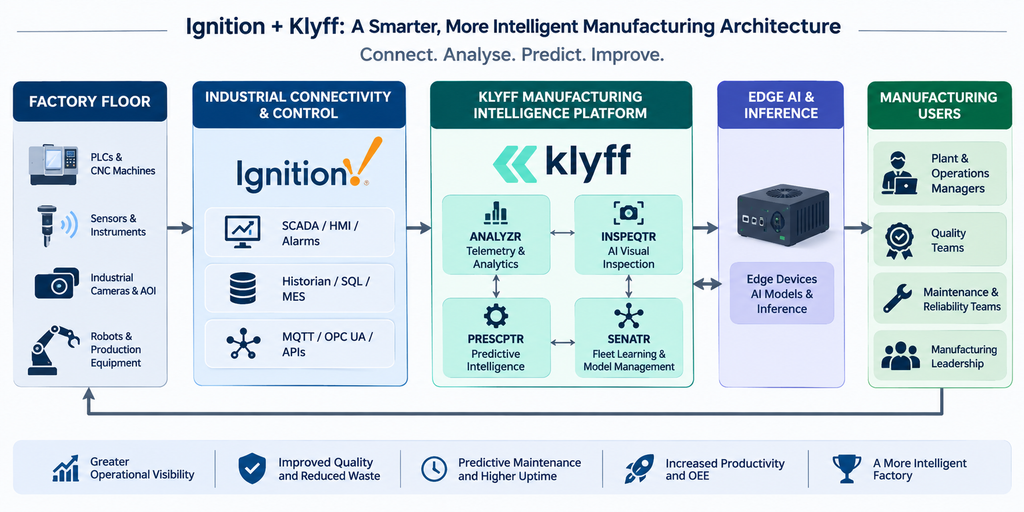
Conceptual architecture. The exact interfaces, data flows, and control boundaries should be designed for each plant. The diagram illustrates a common pattern, not a mandatory product configuration.
Understanding the architecture
Layer 1: Factory floor
The manufacturing environment contains the machines, PLCs, CNC equipment, sensors, cameras, robots, and other production assets generating operational information.
Layer 2: Ignition - Industrial connectivity and operational systems
Ignition connects to the industrial environment and provides the operational application layer.
It can collect machine information, manage alarms, expose process data, store historical information, and provide SCADA/HMI interfaces.
Existing MES systems can continue operating as before.
Layer 3: Klyff - Manufacturing intelligence
Klyff receives selected data from Ignition and other appropriate sources.
The four modules provide complementary capabilities:
- Analyzr consolidates telemetry and delivers manufacturing visibility.
- Inspeqtr analyses images and identifies product defects.
- Prescptr analyses machine and process behaviour for predictive intelligence.
- Senatr supports model management and improvement across distributed deployments.
Layer 4: Edge AI
AI models can run close to the production environment on supported edge hardware.
For visual inspection, camera images can be processed locally. For predictive applications, relevant machine data can be analysed at the edge or through an appropriate Prescrptr SDK deployment.
Model updates and management can be coordinated through Klyff.
Layer 5: Manufacturing decision-makers
The combined solution provides different teams with information relevant to their responsibilities.
- Plant managers get an integrated view of production and asset performance.
- Quality managers get defect classifications and inspection intelligence.
- Maintenance teams get equipment health insights and predictive alerts.
- Operations directors get a broader view of manufacturing performance.
Integration options
The exact integration approach depends on the customer’s existing Ignition architecture and Klyff deployment.
Potential approaches include:
| Integration method | Potential application |
|---|---|
| MQTT / Sparkplug B | Streaming selected machine telemetry |
| OPC UA | Accessing relevant industrial tags and data |
| REST APIs / HTTP | Application-level data exchange |
| SQL / historian integration | Historical process and production analysis |
| Webhooks/events | Sharing alerts and AI inspection results |
| Edge interfaces | Connecting cameras, sensors and AI inference applications |
A key architectural principle is to avoid unnecessary duplication.
If Ignition already collects a machine signal reliably, there is often no reason to introduce another independent connection to the PLC simply to feed Klyff.
Instead, the two platforms can exchange selected information through an agreed integration layer.
Likewise, time-sensitive control loops, machine interlocks and safety functions should remain within appropriately designed and validated industrial control systems. AI-generated recommendations should not automatically become control commands without engineering validation and suitable safeguards.
Real-world manufacturing scenarios: What the combined platform can achieve
The value of this architecture becomes clearer when applied to actual manufacturing environments.
Scenario 1: Automotive component manufacturer
The challenge
An automotive component manufacturer operates multiple CNC machines. It already uses Ignition to monitor machine status, production counts, cycle times, and downtime.
The manufacturer wants to improve equipment availability and reduce quality-related losses.
Using Ignition
- Collect CNC machine operating information.
- Monitor production status.
- Capture cycle times.
- Display alarms and machine downtime.
- Maintain historical process information.
Adding Klyff
- Analyzr consolidates machine and production telemetry.
- Prescptr analyses relevant operating parameters to identify abnormal behaviour and potential equipment problems.
- Inspeqtr can introduce AI-based inspection of machined components.
- Senatr supports the management and improvement of AI models across production locations.
The outcome
The manufacturer moves beyond knowing that a machine stopped or a part failed inspection.
It gains additional intelligence into potential causes, developing equipment issues and recurring quality patterns.
Scenario 2: PCB manufacturing facility
The challenge
A bare PCB manufacturer operates two production lines. Existing systems provide machine monitoring and production reporting, but quality teams still spend considerable time investigating defects.
Using Ignition
- Monitor production lines.
- Collect relevant process parameters.
- Track machine status and production counts.
- Capture downtime and operational events.
Adding Klyff
- Analyzr consolidates line-level production and process information.
- Inspeqtr identifies and classifies defects using image-based AI inspection.
- Inspection results can be associated with production context.
- Quality teams can analyse defect frequency by line, machine, product and shift.
- Prescptr can investigate relevant process patterns that may be associated with equipment or quality abnormalities.
The outcome
Quality teams gain a more detailed understanding of defects, while operations teams can investigate relationships between production conditions and quality outcomes.
This creates a foundation for moving from defect reporting towards defect prevention.
Scenario 3: Plastic injection moulding manufacturer
The challenge
A manufacturer operates several injection moulding machines producing multiple plastic components.
The plant experiences variations in cycle time, inconsistent product quality, occasional machine downtime, and manual inspection bottlenecks.
Using Ignition
- Collect machine cycle information.
- Monitor injection pressure and temperature where available.
- Track machine status and downtime.
- Display production counts and operating performance.
Adding Klyff
- Analyzr provides a consolidated view of all moulding machines.
- Inspeqtr identifies visual defects such as flash, short shots, sink marks, discoloration, and surface imperfections.
- Prescptr analyses available process and equipment data for abnormal patterns.
- Senatr supports model management as the manufacturer expands AI applications to additional machines or plants.
The outcome
The manufacturer can connect production performance with quality intelligence, identify recurring patterns, and establish a more data-driven approach to process improvement.
Scenario 4: Multi-plant manufacturing enterprise
The challenge
A manufacturer operates several facilities with different equipment, production systems, and operating conditions.
Corporate leadership wants consistent performance reporting, while individual plants need to retain control over sensitive production data.
Using Ignition
Each plant can continue operating its existing industrial automation and SCADA architecture.
Adding Klyff
- Analyzr can provide consolidated manufacturing telemetry.
- Inspeqtr and Prescptr can support site-level AI applications.
- Senatr can help distribute model improvements across participating plants without requiring raw production data to be centralized.
The outcome
The organization can move towards standardized manufacturing intelligence while respecting plant-level data residency and operational requirements.
The commercial opportunity for industrial automation partners
The combination of Ignition and Klyff is not just a technology proposition. It creates a potential business model for industrial automation companies.
Consider an integrator that already works with 30 manufacturing customers.
It has implemented Ignition at several plants and maintains ongoing relationships with operations and engineering teams.
Those customers may already have machine data available, but they may not have implemented advanced AI-based quality inspection or predictive maintenance.
The integrator now has an opportunity to introduce additional solutions without replacing the existing systems.
A broader portfolio of manufacturing solutions
| Existing integrator offering | Expanded offering with Klyff |
|---|---|
| SCADA implementation | SCADA + manufacturing intelligence |
| Machine monitoring | Machine health analytics and predictive insights |
| Production dashboards | Cross-line and cross-plant intelligence |
| Quality reporting | AI-powered visual inspection |
| Historical data collection | Data-driven process and quality analysis |
| MES implementation | MES + AI-driven quality and operational insights |
| IIoT projects | IIoT + edge AI deployment |
| Industrial consulting | Manufacturing AI and intelligence consulting |
A potential partner delivery model
The collaboration can be structured around the complementary expertise of both organizations.
| Responsibility | Industrial automation partner | Klyff |
|---|---|---|
| Customer discovery | Lead | Support |
| Plant-floor assessment | Lead | Support |
| PLC and equipment integration | Lead | Support where required |
| Ignition implementation | Lead | Integration support |
| Klyff platform deployment | Joint | Lead |
| AI model development | Joint | Lead |
| Edge deployment | Joint | Platform and model support |
| Customer training | Joint | Platform-specific training |
| Ongoing support | Joint | Platform and AI support |
This model allows integrators to retain ownership of their core industrial automation expertise while expanding into manufacturing intelligence.
Creating recurring revenue
A joint engagement can generate value at multiple stages:
- Initial industrial connectivity and integration project.
- Klyff platform deployment.
- AI inspection or predictive maintenance implementation.
- Ongoing platform subscription.
- Model monitoring and improvement.
- Expansion to additional production lines and facilities.
The result is an opportunity to move beyond one-time automation projects towards longer-term manufacturing technology partnerships.
Why this matters now: The move from Industry 4.0 to intelligent manufacturing
For years, manufacturing digitalization has focused on connecting machines, collecting data and creating visibility.
These investments remain essential.
But the next competitive advantage will increasingly come from what manufacturers can do with the information they already collect.
The emerging manufacturing environment will combine:
- Industrial automation and connectivity.
- Manufacturing execution systems.
- Real-time operational intelligence.
- Computer vision and automated inspection.
- Predictive and prescriptive analytics.
- Edge AI.
- Distributed model management.
No single platform needs to do everything.
The strongest manufacturing architectures will often combine specialized platforms that work together through well-defined interfaces.
Ignition provides a powerful industrial application foundation.
Klyff adds a specialized manufacturing intelligence and edge AI layer.
Together, they create an opportunity for manufacturers to move beyond connected factories towards factories that can continuously learn, adapt, and improve.
Frequently asked questions
Is Klyff a replacement for Ignition?
No. Klyff is designed to complement industrial automation platforms such as Ignition.
Ignition provides SCADA, HMI, industrial connectivity, monitoring, and application capabilities. Klyff focuses on manufacturing intelligence, AI-powered inspection, predictive intelligence, and edge AI model management.
Can Klyff work with an existing Ignition installation?
Yes, Klyff is designed to integrate with existing industrial data environments through supported interfaces and gateways.
Depending on the implementation, relevant data can be exchanged through MQTT, OPC UA, APIs, SQL, and other supported integration methods.
The precise architecture should be validated against the customer’s Ignition modules, data sources, network design, and Klyff deployment requirements.
Do manufacturers need to replace their existing SCADA or MES systems?
No. The intention is to preserve existing investments.
Manufacturers can continue using Ignition, Sepasoft, and other existing operational systems while introducing Klyff for additional intelligence capabilities.
Does Ignition already offer analytics and AI capabilities?
Ignition has extensive visualization, historical data, scripting, integration, and application development capabilities. Its modular architecture and third-party ecosystem allow it to be extended significantly.
AI functionality can also be developed through integrations and custom engineering.
Klyff’s differentiation is that manufacturing intelligence and edge AI model management are central to its product proposition, rather than requiring every customer or integrator to assemble those capabilities independently.
Can Klyff run AI models locally?
Klyff is designed for edge AI deployment, supporting appropriate edge hardware and on-premises architectures.
This allows manufacturers to process sensitive production information locally, subject to the selected deployment configuration.
Can an Ignition integrator implement Klyff?
Klyff sees industrial automation integrators as important potential technology and implementation partners.
An integrator can continue delivering its existing Ignition projects while working with Klyff to introduce manufacturing analytics, AI inspection, and predictive capabilities.
A structured technical evaluation and partner onboarding process can establish the appropriate responsibilities.
Does using both platforms increase complexity?
Not necessarily.
A well-designed architecture should minimize duplicated data collection, preserve existing control systems, and exchange only the information required by each platform.
The integration should be designed around clear responsibilities, security boundaries, and customer requirements.
The objective is to increase manufacturing intelligence without introducing unnecessary complexity.
The opportunity: Build more intelligent factories together
Manufacturing technology is evolving beyond simply connecting equipment and displaying operational information.
The challenge now is to make that information useful.
Ignition has helped manufacturers and integrators establish the industrial connectivity and application foundations required for digital manufacturing.
Klyff builds on this foundation by helping manufacturers apply AI and advanced analytics to the information generated across their factories.
For industrial automation integrators, this creates an opportunity to expand their portfolio, differentiate their offerings, introduce recurring revenue streams and deliver additional measurable value to their customers.
For manufacturers, it means they can build on their existing investments while taking the next step towards intelligent operations.
At Klyff, we believe the future belongs to factories that don’t just collect data, but learn from it.
We invite Ignition system integrators, industrial automation companies, and manufacturing technology partners to explore how we can work together to make that future possible.
Already implementing Ignition for manufacturing customers? Let’s explore how Klyff can extend the value of your next project.
Book a technical discussion with Klyff
Klyff - Manufacturing Intelligence. From connected operations to intelligent factories.