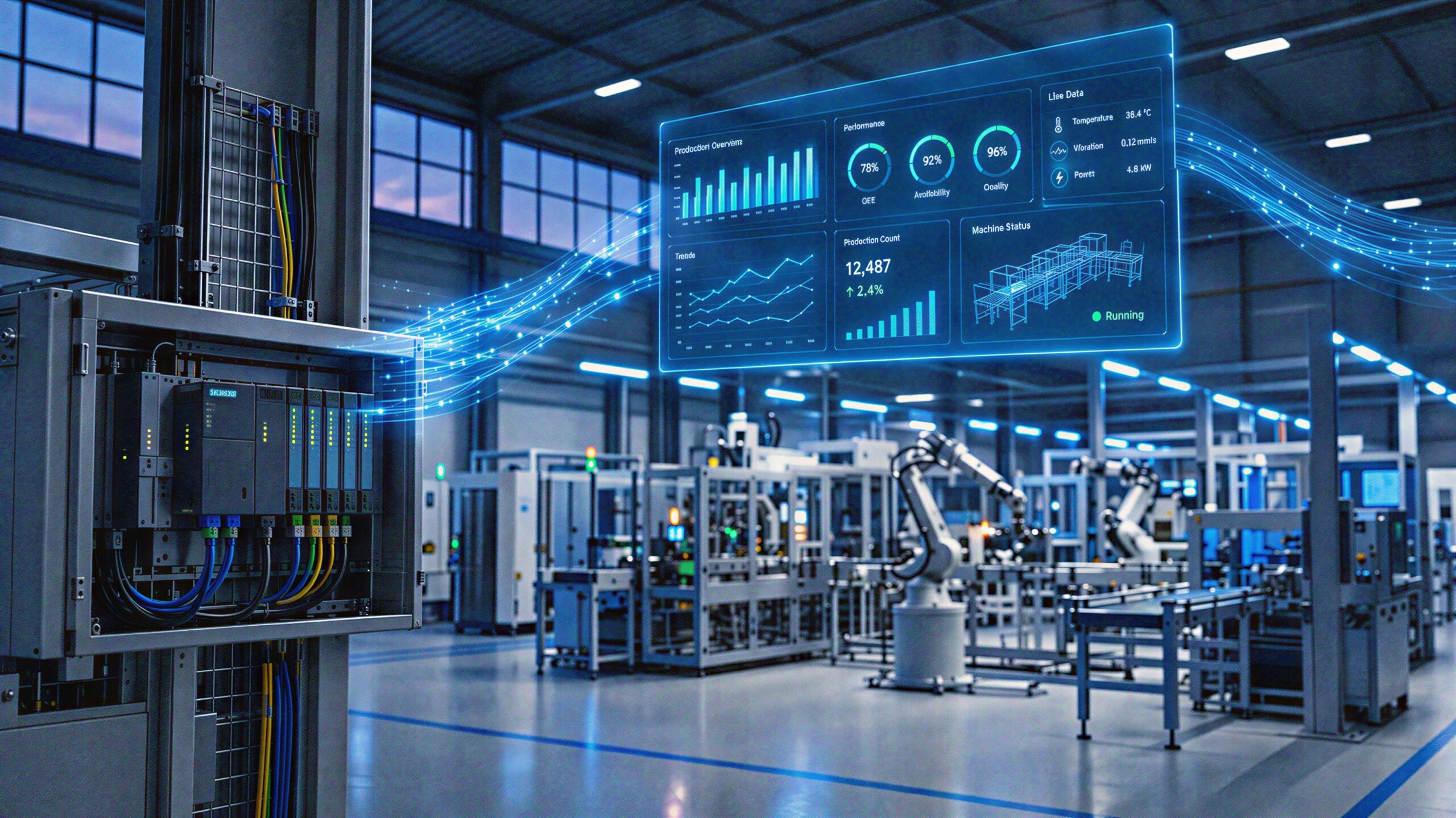
Modern industrial plants generate a massive volume of operational data every second across assembly cells, CNC stations, packaging lines, and process skids. Yet in most facilities, the vast majority of this operational data stays locked inside local control loops. Reliable industrial PLC telemetry is the missing link for real-time Overall Equipment Effectiveness (OEE), condition-based maintenance, and automated quality monitoring.
Bridging the divide between Operational Technology (OT) and Information Technology (IT) has never been straightforward. Automation engineers care about microsecond determinism, uninterrupted production, and strict network isolation. Enterprise software architects, on the other hand, need open standards, scalable data ingestion, and cloud analytics.
Trying to query production controllers directly from corporate platforms introduces real operational risks: communication coprocessor overload, scan-time jitter, and security gaps that are hard to close after the fact.
The sustainable answer is a proven combination: OPC-UA as the open, vendor-neutral protocol for extracting data from industrial controllers, paired with the Klyff Platform to contextualize, process, and turn raw registers into manufacturing intelligence you can actually act on.
The 3-Tier Industrial Telemetry Architecture
Scaling industrial telemetry across dozens of lines and hundreds of machine cells calls for a decoupled, layered approach. Instead of letting enterprise applications query PLCs directly, a solid plant architecture splits the data lifecycle into three distinct, secure tiers.
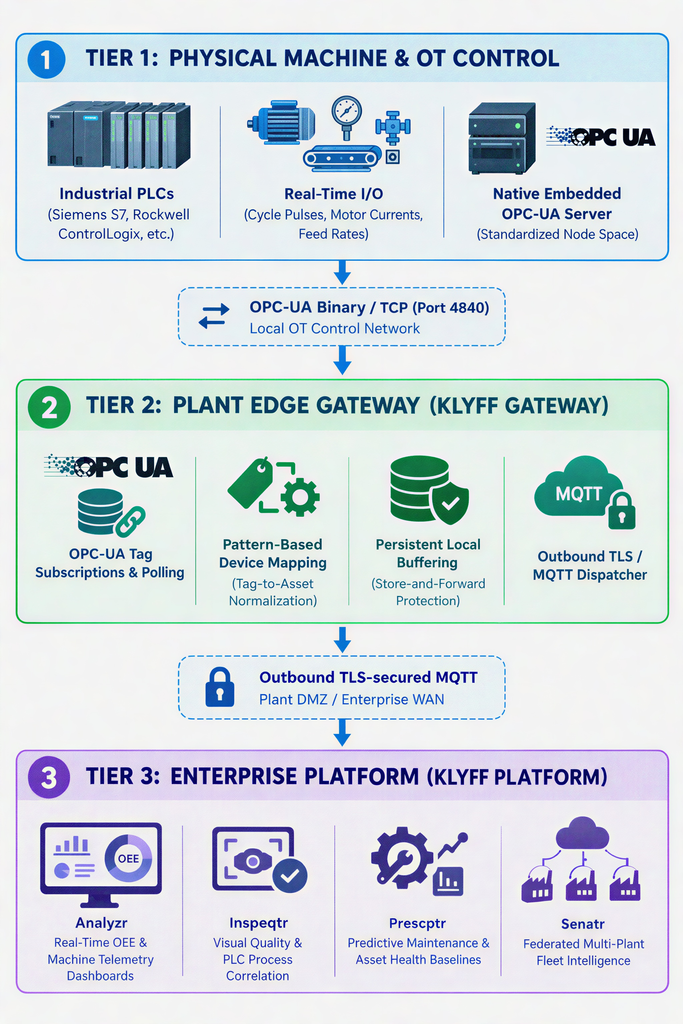
Tier 1: Physical Machine and OT Control
At the machine level, industrial PLCs (Siemens S7-1200/1500, Rockwell ControlLogix, Beckhoff TwinCAT, Schneider Electric Modicon, and similar) run the deterministic logic that keeps physical plant equipment moving. Modern PLCs expose operational tags through integrated, standards-compliant OPC-UA servers. This tier lives entirely on the local machine network, so control loops and safety systems are never exposed to enterprise traffic.
Tier 2: Plant Edge Gateway (Klyff Gateway)
Stationed physically in the plant control room or electrical cabinet, the edge gateway acts as the protocol mediator and security boundary between OT and IT. The Klyff Gateway maintains persistent local connections to machine OPC-UA servers, handles tag subscription and polling, normalizes tag naming using configurable device and tag mapping patterns, and buffers data locally so network dropouts don’t cause data loss.
Tier 3: Enterprise Platform (Klyff Platform)
This is the centralized core of the industrial data ecosystem, deployed either on private enterprise infrastructure or managed cloud environments. Tier 3 ingests normalized telemetry from edge gateways and delivers operational value through Klyff’s four product modules: Analyzr, Inspeqtr, Prescptr, and Senatr, covering plant visibility, quality inspection, predictive maintenance, and multi-site fleet intelligence respectively.
Why Raw OPC-UA Needs an Enterprise Telemetry Engine
OPC Unified Architecture (IEC 62541) has earned its place as the de facto open communication standard on the plant floor. It offers platform independence, built-in cryptographic security (x509 certificates and encryption), and an object-oriented information model.
Still, deploying an OPC-UA server on a machine controller only solves connectivity. It doesn’t solve enterprise contextualization:
- Complex, nested address spaces. An industrial PLC may expose tens of thousands of tags organized across deep, vendor-specific folder hierarchies (
ns=2;s=Line3.Station4.Spindle.AnalogInputs.MotorCurrent). Consuming applications can’t easily interpret or query these structures at enterprise scale without some form of normalization. - Missing operational context. A raw tag reporting a numeric value like 4 or 0 doesn’t tell you anything about business context. Is the machine faulted, changing tooling, starved for material, or waiting on planned maintenance? Raw telemetry needs to be turned into stateful operational events, and just as importantly, needs documented tag meaning (units, valid ranges, what a boolean actually represents) from whoever programmed the PLC. OPC-UA itself carries no guarantee that tag names are self-explanatory.
- Network volatility. High-speed Ethernet networks on the plant floor are rock-solid locally, but enterprise wide-area networks and cloud connections experience latency spikes, maintenance windows, and physical disruptions. Direct cloud connections from PLCs risk silent data loss during outages.
A complete telemetry strategy pairs the machine-level fidelity of OPC-UA with an intelligent edge gateway and an enterprise manufacturing intelligence platform.
At the Edge: Ingesting PLC Data with Klyff Gateway
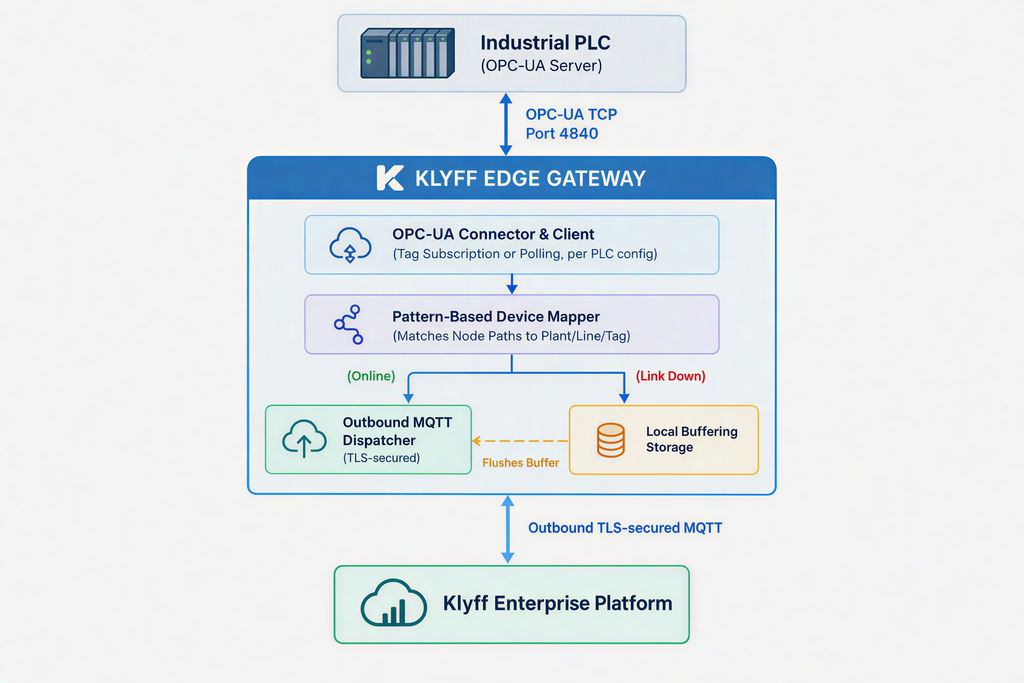
The Klyff Edge Gateway sits on the boundary between the OT network and the enterprise IT network, keeping PLC communication reliable while streaming telemetry cleanly upstream.
Subscriptions vs. Polling
Traditional SCADA systems often poll every PLC tag on a fixed timer, requesting large tag sets every few hundred milliseconds. At scale, this wastes network bandwidth and burns controller compute cycles.
Where the target PLC supports it, the Klyff Gateway can use OPC-UA’s built-in subscription mechanism (Monitored Items and DataChangeSubscriptions), so the PLC’s own OPC-UA server pushes updates only when a value changes beyond a configured deadband. That cuts down on unnecessary traffic for steady-state values. Polling is still available and remains the more broadly compatible fallback for PLCs whose OPC-UA implementation doesn’t handle subscriptions reliably. Sampling intervals and deadbands are configurable per deployment rather than fixed.
Pattern-Based Device Mapping
In facilities with dozens of automated stations, hand-configuring individual tag mappings for every device quickly becomes unmanageable. The Klyff Gateway supports regex-style path patterns to match multiple similarly structured OPC-UA nodes to logical asset and telemetry mappings in a single rule. A pattern like Objects\.Line3\.Station_\d+ can match every station under Line3 that follows that naming convention, instead of requiring a separate hand-written entry per station.
This cuts the manual mapping burden substantially when a plant has many identically structured machines. It’s worth being precise about what this does and doesn’t do: it matches nodes that already exist and already follow the expected naming pattern at the time the connector scans or subscribes. It isn’t a substitute for verifying a new station’s actual tag structure the first time it’s commissioned, since real-world PLCs vary in how consistently they’re named in practice.
Store-and-Forward Local Buffering
When external WAN or enterprise networks disconnect, production on the plant floor doesn’t pause. If telemetry can’t be delivered upstream, the Klyff Gateway diverts normalized data into local persistent storage instead of discarding it.
Once connectivity is restored, the gateway resumes delivery from that local buffer. This is a genuinely load-bearing part of the architecture. It’s what keeps a WAN blip from turning into a silent gap in OEE calculations, shift reporting, or quality audit trails.
At the Enterprise: Powering the Klyff Platform with PLC Telemetry
Once telemetry leaves the plant edge, the Klyff Platform takes over, converting raw time-series numbers into actionable plant intelligence and routing them into four product modules:
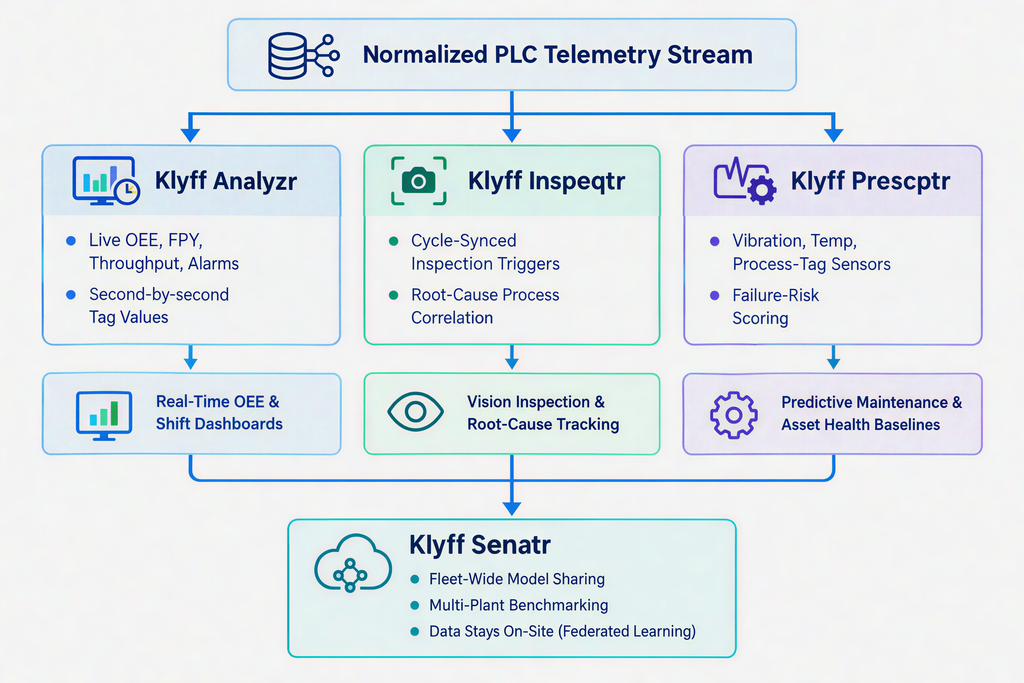
1. Klyff Analyzr: Real-Time OEE and Operational Telemetry
Analyzr is Klyff’s unified telemetry layer. It ingests data from edge devices and protocols (MQTT, CoAP, HTTP, and, through gateways, industrial protocols including Modbus and OPC-UA), normalizes it, and presents live, actionable dashboards for plant managers and supervisors. Operations teams get a single pane of glass across lines and cells, live second-by-second values for tags like temperature, vibration, pressure, and OEE, historical drill-down for root-cause analysis, and configurable threshold and anomaly alerting routed to the right channels.
2. Klyff Inspeqtr: Visual Quality and Process Correlation
Inspeqtr targets automated optical inspection, aiming to improve First Pass Yield (FPY) by 2 to 4 points and catch subtle defects that standard AOI misses, running on existing cameras and edge hardware while keeping images secure on-prem. It supports PCB, automotive, and pharma production lines.
- Cycle-synchronized inspection. Coordinates inspection timing with machine cycle signals from the PLC so images are captured at the right moment in the process.
- Root-cause parameter correlation. Correlates a detected defect with the PLC process parameters recorded during that same cycle, things like injection pressure, spindle feed rate, or tool temperature, helping connect what went wrong to why.
3. Klyff Prescptr: Predictive Maintenance and Asset Health
Prescptr uses existing vibration, temperature, and process-tag sensors, no rip-and-replace required, targeting a 30 to 50 percent reduction in unplanned downtime on monitored assets and a 20 to 30 percent increase in Mean Time Between Failures (MTBF).
- Dynamic operating envelopes. Evaluates real-time sensor signatures against learned machine baselines under specific operational loads.
- Early anomaly detection. Aims to flag mechanical degradation before it becomes a failure event.
- Condition-based work orders. Shifts maintenance from fixed calendar schedules toward condition-based intervention.
4. Klyff Senatr: Federated Cross-Plant Fleet Intelligence
Senatr shares model improvements across plants while keeping raw production data on-site, a federated-learning approach designed to stay compliant with GDPR, trade-secret, and data-residency requirements. New defect detectors or predictive models can roll out fleet-wide without centralizing sensitive production data.
- Fleet-wide benchmarking. Compares identical equipment across multiple plants to identify performance and efficiency gaps between otherwise similar cells.
- Federated learning without data movement. Aggregates learnings across the corporate fleet without moving raw operational data off-site.
Security and Deployment Principles for Industrial Telemetry
Deploying modern telemetry across critical industrial infrastructure should follow established OT/IT security principles. The specifics below reflect general industrial best practice for this kind of architecture. Treat them as recommended design principles for a deployment, not as a fixed spec of any single product.
| Architecture Domain | Risk Vector | Recommended Practice |
|---|---|---|
| Network Boundary | Cross-subnet intrusion from IT to OT | Segment OT and IT networks physically or logically; the edge gateway should only make outbound connections toward IT/cloud |
| Authentication | Rogue or untrusted client connections | Use OPC-UA’s built-in x.509 certificate-based authentication where the PLC supports it |
| Access Control | Accidental control commands or setpoint changes | Scope the gateway’s OPC-UA session to read-only wherever the integration doesn’t require write-back |
| Staging & Commissioning | Downtime caused by testing on live equipment | Validate gateway config and tag mapping against a simulated OPC-UA server before touching production PLCs |
1. Network Segmentation (OT/IT Boundary)
Best practice keeps the edge gateway from ever bridging OT and IT networks at the routing layer. This is commonly done with dual-interface industrial hardware: one interface talks only to the machine network (no default gateway, no external routing), while the other carries only outbound, encrypted traffic to the enterprise side. This is a standard industrial architecture pattern, not something unique to any one gateway product.
2. Outbound-Only Connections
The gateway should initiate outbound connections toward the platform over TLS-secured MQTT or HTTPS, rather than accept inbound connections into the plant network. That means no inbound firewall ports need to open into the industrial network, which limits exposure to external scanning or unauthorized access once the secure outbound tunnel is up.
3. Simulation-First Staging
Industrial telemetry configurations should never be tested directly on active production machines. Before rolling out gateway updates, tag patterns, or mapping configuration to a live assembly line, automation engineers should validate the configuration against a simulated OPC-UA server that mirrors the machine’s address space structure. That lets you verify tag paths, mapping patterns, and connectivity without risking a production interruption, and it surfaces integration problems, like misconfigured paths or security mismatches, in a controlled environment before they reach the floor.
Transforming Machine Signals into Enterprise Value
Bridging the divide between Operational Technology and Information Technology is no longer an optional digital initiative. It’s a foundational requirement for agile, data-driven manufacturing.
By combining the standardized, vendor-neutral connectivity of OPC-UA with the buffering and security boundary of a plant edge gateway, and the analytics of the Klyff Platform (Analyzr, Inspeqtr, Prescptr, and Senatr), manufacturers can unlock real-time OEE, correlate quality defects with process variables, predict equipment failures earlier, and scale intelligence across their global fleet.