Deciding the right silicon for your manufacturing line is like an art and science question. Every Klyff module runs AI on or near the machine it’s watching. Not in a distant data center. That single choice makes the platform’s numbers possible. Most Edge AI solutions for the manufacturing industry would have to follow these stringent requirements. We take the example of the Klyff platform, but it is easily generalised for other Edge AI solutions. This article helps you identify the right silicon that will be needed for your use case to make your manufacturing line efficient and effective.
The Case for Edge, in Four Points
- Speed. Inspeqtr flags defects in under 200ms. That only works if the decision happens on the line. A camera that phones home first is already too slow.
- Data stays yours. Klyff offers a full on-prem option. Your images, vibration data, and process tags never have to leave your site. That matters for trade secrets and for GDPR-style data residency rules.
- No forklift upgrade. Klyff doesn’t need one expensive processor. It fits a ladder of silicon, from cheap microcontrollers to full industrial PCs. It runs on the cameras and edge hardware you already own.
- Fleet learning, no data movement. Senatr lets a defect model learned at one plant improve every plant’s model. This happens in weeks, not months. Only compact model updates cross the network - never raw data.
The Three Chips That Matter
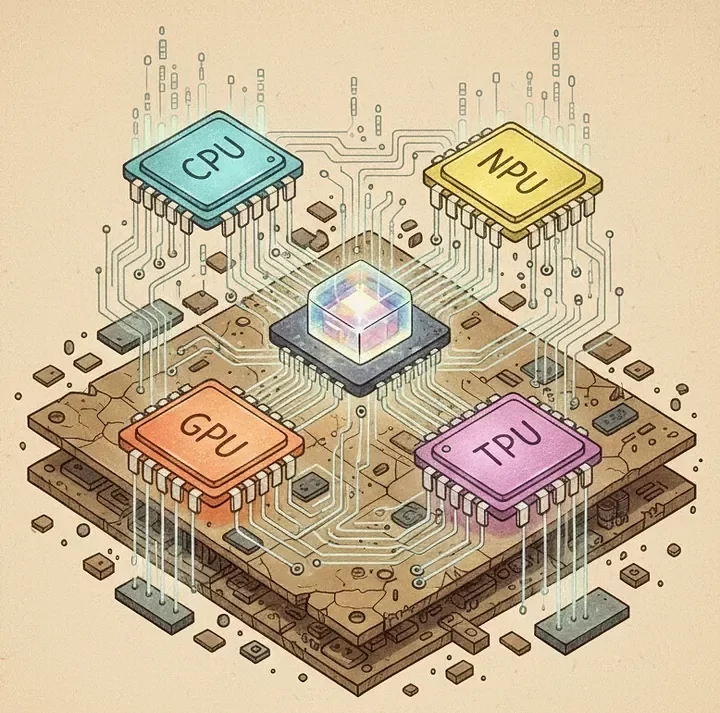
Three kinds of compute show up in every edge AI deployment.
- CPU handles sequential logic and orchestration. Every gateway runs one. It ingests MQTT, CoAP, or HTTP traffic and decides when to call the NPU.
- GPU handles massively parallel matrix math. You’ll find it in larger edge boxes and the central training server. It’s less common at the camera level.
- NPU handles low-power, purpose-built tensor math. It’s the workhorse behind Inspeqtr’s real-time vision models.
The metric that matters most is TOPS - Tera Operations Per Second. It’s a rough proxy for how much neural-network math a chip can do. Real-time video defect detection (like Yolo models) needs about 2–3 TOPS. Simple keyword models need under 1 TOPS. On-device LLM reasoning needs 40+ TOPS.
One more thing worth knowing: most Klyff partner chips use unified memory. CPU, GPU, and NPU share one RAM pool instead of separate VRAM. That skips a costly copy step between components.
The Klyff Silicon Ladder
Klyff doesn’t force every site onto the same chip. It matches the tier to the job.
| Tier | Example Part | Best For |
|---|---|---|
| 0 - Sensor node | STM32N6 (~0.6 TOPS) | Cheap, low-power pre-screening before waking a heavier unit |
| 1 - Smart camera | Intel Movidius Myriad X (up to 4 TOPS) | Real-time Inspeqtr-style defect detection, up to 8 cameras per chip |
| 2 - Industrial edge box | Intel Core Ultra Series 3 (up to 180 TOPS) | Multi-camera lines, robotics, or a site-level Senatr node |
| 3 - Client/PC gateway | Intel N-series or Core Ultra | Plant-manager dashboards and HMI stations |
| 4 - Central/on-prem server | Intel Xeon 6+, optionally with Crescent Island GPU | Federated learning aggregation across all sites |
Tiers 0–2 put CPU, NPU, and usually GPU on one die. That keeps power draw and cost low for devices that live beside industrial equipment for years. Tier 4 is the one spot where a discrete accelerator card makes sense, since training throughput benefits directly.
Matching the Four Pillars to Silicon
- Analyzr handles ingest, protocol translation, and dashboards. That’s mostly I/O and orchestration - a CPU job, not a matrix-math job. It rarely touches the NPU.
- Inspeqtr runs real-time defect detection. It leans on the NPU. But the image signal processor (ISP) upstream matters just as much. A defect model can’t beat the accuracy of the sensor data feeding it. This module must run fully on-device - the latency budget can’t survive a network round trip.
- Prescptr scores predictive maintenance from vibration, temperature, and process tags. That’s mostly signal processing, not deep vision. It leans on the DSP block that every chip in the ladder already carries.
- Senatr runs fleet-level federated learning. It uses the NPU at the edge for local updates and the GPU centrally for aggregation. This is the module where the CPU-versus-GPU split matters most.
How Data Actually Moves
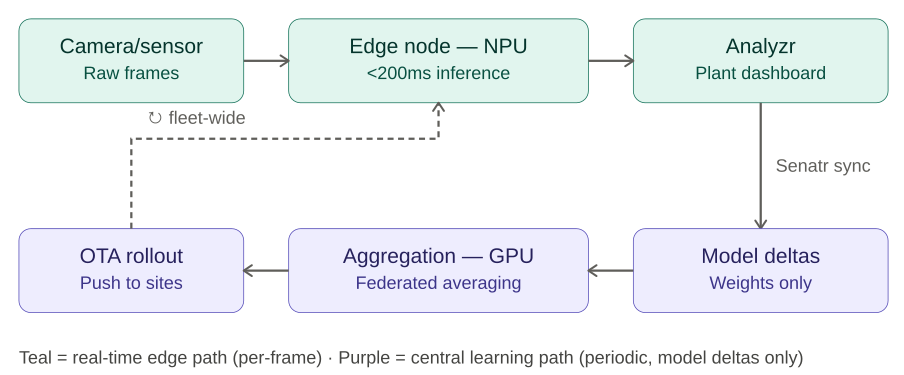
The real-time path never leaves the edge device. A camera feeds a Tier 0/1 node. That node runs Inspeqtr or Prescptr locally and makes a decision in under 200ms.
Analyzr aggregates telemetry into a plant-level view. It passes only model deltas upward - never raw images or sensor data.
The learning path works differently. It’s slow and centralized on purpose. Compressed model updates travel to a Tier 4 server on a periodic schedule. There, federated averaging across every site produces one improved global model. That model then rolls back out to every edge node over the air.
Where This Goes Next
Most of Klyff’s workloads today are discriminative inference - defect detection, anomaly scoring, telemetry. Each is a single forward pass through a model, not generative AI. That’s why Tier 0–2 NPUs handle today’s job just fine.
Two things could change that. First, Senatr’s aggregation loop already works like a hybrid edge-cloud agent: fast decisions at the edge, slower reasoning centrally. A future auto-rollout decision-maker would live at Tier 4.
Second, Intel Core Ultra chips already carry enough headroom to run small LLMs locally. That opens the door to on-prem plant queries - “why did Line 3’s defect rate spike this shift?” No plant data has to leave the site.
A Quick Checklist for Scoping New Sites
- Latency budget. Sub-200ms or safety-critical work needs Tier 0–2, fully on-device.
- Environment. Extreme temperature, vibration, or dust calls for industrial-grade boards, not consumer PC hardware.
- Power and cost per unit. Hundreds of cameras on a line? Go Tier 0/1. A handful of aggregation points? Tier 2/3 can pay off.
- Existing hardware. If cameras or sensors are already in place, Analyzr normalizes whatever protocol they speak.
- Data residency. Regulatory or trade-secret rules usually decide whether Tier 4 runs on-prem or in the cloud.
- Multi-site learning. More than one site sharing learning? Plan the Senatr sync path early - bandwidth, versioning, and a clear line between “model” and “data.”
Bottom line: pick the lowest tier that meets your latency and environmental needs. Extra silicon just adds cost and power draw. It won’t move the metrics that matter - defect escape rate, downtime, deployment speed.
Conclusion
The right silicon to solve the problem depends on the use case at hand. You might add heavier silicon, and that will be more like a cannon to kill an ant. You go lower, and you might not get the speed and accuracy that you desire. The right balance will give you the horsepower at the right cost and the accuracy that your business needs.
Get in touch with us to go through the details of your use case and what hardware silicon will work best for you.