
klyff.com

Prescptr℠
Prescriptive Maintenance for Infinite Uptime

Turn vibration, temperature, and process data into early warnings & recommendations, so you fix equipment on your schedule, not when it fails.

Klyff Federated Learning lets every plant benefit from what the others learn—while keeping all production data on site.
Problem Statement

The cost of Unplanned Downtime:

  • Unplanned outages: $10K–$100K per hour in lost production, labor, and overtime
  • Over-servicing equipment: Time-based PM that replaces parts too early “just in case”
  • Scattershot data: Sensors, SCADA, and PLCs collecting data that no one has time to analyze
  • Firefighting culture: Maintenance teams living in reactive mode instead of planned work

Klyff Predictive Maintenance converts your existing sensor and process data into reliable early warnings—often 48–72 hours before failure.

Klyff Prescptr Delivers
  • Unplanned downtime: 30–50% reduction on monitored assets

  • MTBF (Mean Time Between Failures): 20–30% increase

  • Maintenance cost: Fewer emergency repairs, lower overtime, better spares planning

  • Payback: Often in one prevented downtime event per line or asset

Built for the realities of the plant:

  • Uses your existing sensors (vibration, temperature, pressure, current, acoustics, process tags)

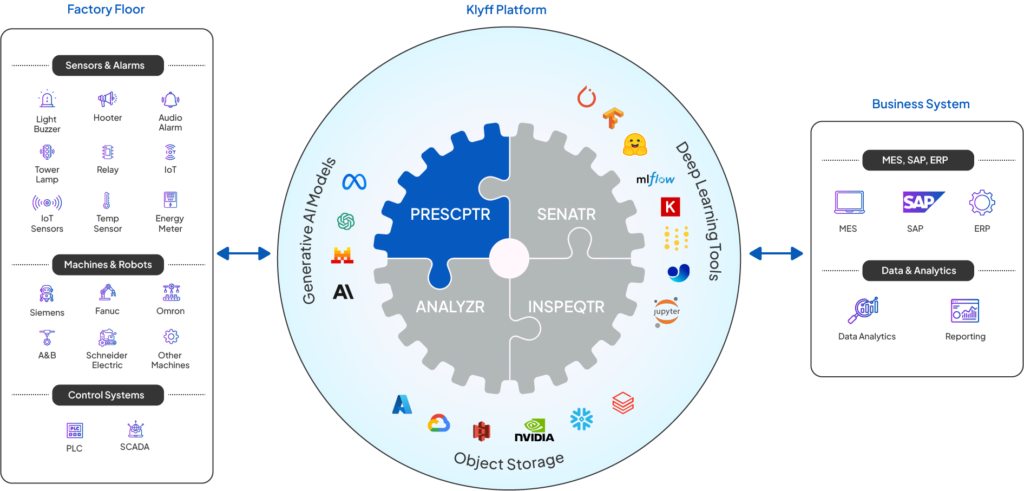
  • Integrates with SCADA, historians, PLCs, and CMMS

  • Runs on-prem or at the edge, not in a remote data center

  • Operates safely in air-gapped environments

How Klyff Prescptr Works

Asset & Failure Mode Mapping

  • Identify critical assets by downtime cost and failure history
  • Define relevant failure modes: bearings, seals, pumps, fans, motors, gearboxes, furnaces
  • Map available sensors and data sources (SCADA, PLC, historian, logs)

Data Ingestion & Baseline Modeling

  • Ingest historical data where available; otherwise start streaming live signals
  • Establish a “healthy baseline” for each asset under normal operating condition
  • Train anomaly detection and degradation models tailored to each asset type

Early Warning & Alerting

  • Deploy models at the edge or on-prem servers
  • Generate actionable alerts with lead time (e.g., “bearing degradation likely within 72 hours”)
  • Intelligent action to elongate the downtime timeline ( reducing speed by 10% will extend its life until the weekend)
  • Integrate with your CMMS or work order system to automatically create maintenance jobs

Continuous Learning & Optimization

  • Confirm true positives and false positives with your maintenance team
  • Use feedback loops to refine models and thresholds
  • Extend coverage to more assets and lines as value is demonstrated

Why Klyff Senatr for federated learning
  • Edge-first architecture: Works where cloud cannot (air-gapped or latency-sensitive environments)

  • Hardware and vendor agnostic: Use your existing sensors, PLCs, and historians; we don’t force new hardware

  • Industrial-grade MLOps: Automated retraining, version control, and monitored drift across hundreds of assets

  • Operator-friendly outputs: Clear risk scores and time-to-failure ranges, not data science jargon

  • Fast time-to-value: Focus on your top 5–10 critical assets first, then expand

Examples

Automotive / Metals / Heavy Manufacturing

  • Critical rotating equipment: motors, pumps, fans, compressors, conveyors, rollers

  • High-value assets: furnaces, kilns, paint booths, stamping presses

  • Complex process lines with many interacting variables (temperature, speed, load, pressure)

Food & Beverage / Consumer Goods

  • High-speed packaging, filling, and bottling lines

  • Conveyance systems and critical refrigeration/chilling equipment

  • Pumps, agitators, mixers, and drive trains

Energy & Utilities (where relevant)

  • Turbines, generators, critical pumps and valves

  • Continuous process equipment with high uptime requirements

FAQs

SCADA alarms typically use static thresholds (e.g., vibration > X). Klyff learns patterns over time and recognizes subtle trends—like a gradual rise in vibration at a specific frequency—that indicate upcoming failure before thresholds are breached.

Often no. We start with what you already measure. If coverage is poor on a critical asset, we’ll recommend low-cost additional sensors only where the ROI is clear.

Yes—because alerts are concrete (“bearing on motor M-204 likely to fail within 72 hours”) and integrated into existing tools (CMMS, work orders), not just dashboards.

Predictive maintenance uses IoT sensors and machine learning to forecast when a machine might fail based on real-time data, whereas prescriptive maintenance goes further by analyzing data to recommend or automate specific actions to prevent that failure. Predictive answers “what will happen,” while prescriptive answers “how to fix it”.

Key Differences:
Actionability: Predictive identifies potential issues; Prescriptive provides solutions (e.g., “reduce speed by 10% to prevent overheating”).
Technology: Prescriptive relies on more advanced AI, simulation algorithms, and deeper data analysis than predictive.
Complexity & Cost: Predictive is easier to implement; Prescriptive requires higher-quality data and infrastructure but offers greater long-term optimization.

Examples:
Predictive: A sensor alerts that a bearing will fail in 48 hours.
Prescriptive: A system detects a bearing issue, calculates that reducing speed by 10% will extend its life until the weekend, and automatically adjusts the machine settings.

Selected Customer Success Stories
klyff_favicon

Adaptive Predictive Maintenance

On device inference becomes inaccurate with each passing day. Read how Klyff handled on-device training to keep your models accurate.
klyff_favicon

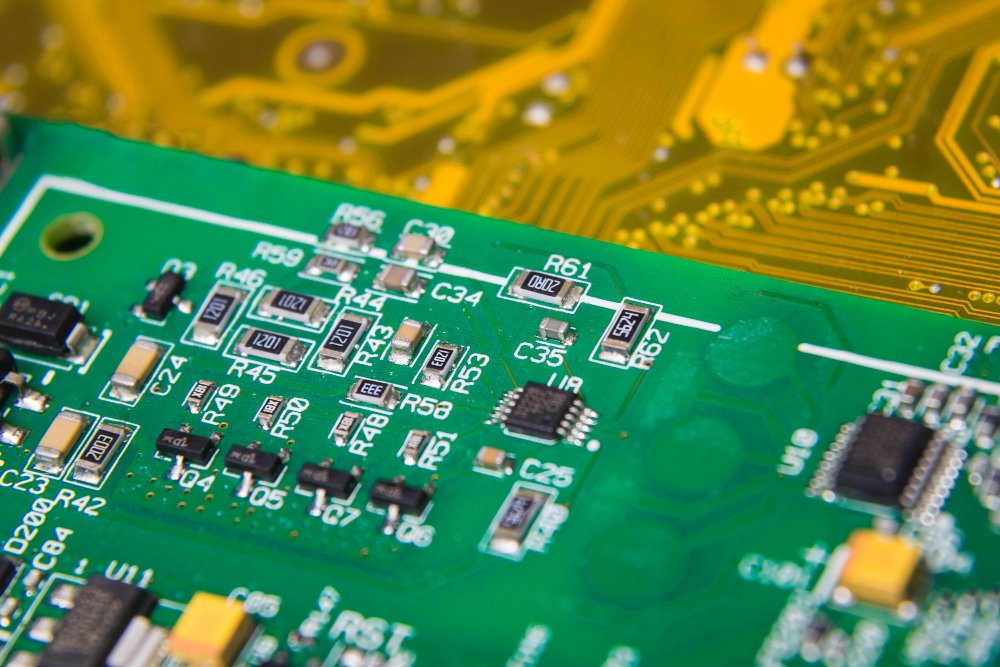
Solder Joint Inspection

Read how Klyff helped reduce false positive rate to <2% and reduce latency from 120ms to 8ms thus resulting in huge cost advtange

klyff_favicon

PPE Compliance in Chemical Plant

Klyff helped a global chemical manufacturer to ensure all workers wore Hazmat suits and respirators in "Zone 1" areas through federated learning

Let us estimate the downtime you could have prevented with Klyff in last 12-24 months

Our Insights to keep you ahead
Scroll to Top